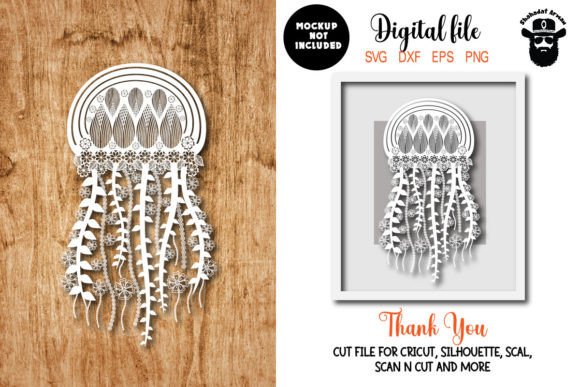
Floral Jellyfish Laser Paper Cut Template
A Designer’s First Glance: Whimsy with Purpose
When I opened the Floral Jellyfish Laser paper Cut Templat, my first thought wasn’t “cute” — it was “curated.” The interplay of organic floral curves and jellyfish tentacles feels intentional, not random. It’s delicate but not fragile; playful but grounded in structure. As a designer who regularly selects embroidery files for client work and small-batch production, I immediately saw its potential on natural-fiber totes, linen tea towels, and baby onesies — pieces where softness and storytelling matter more than flash.
Real-World Use: From Mockup to Market
Last week, I prepped a custom embroidered tote bag for a local botanical boutique. Their brief asked for “ocean-meets-garden” — no florals alone, no marine life alone. The Floral Jellyfish Laser paper Cut Templat landed perfectly there. In my digital mockup, it held up beautifully at 4.2 inches wide on unbleached canvas — clear silhouettes, balanced negative space, and enough internal detail to read as hand-drawn, not algorithmic. When stitched as an applique design (using satin stitch borders and light fill stitch for petals), it looked handmade without demanding expert-level digitizing finesse.
I also tested it as a sweatshirt embroidery on midweight French terry. With proper cutaway stabilizer and a medium-density stitch count (which I confirmed by reviewing the file’s vector paths — clean, closed shapes, no overlapping lines), the design stayed crisp across seams and gentle curves. No puckering. No lost tentacle tips. That’s rare in graphics-heavy designs marketed for Crafts and Graphics use — many sacrifice stitchability for visual flair. This one doesn’t.
Where It Shines — And Where to Pause
- Best for: Tote bag design, baby embroidery (onesies, burp cloths), pillow covers, nursery decor, holiday embroidery (think Easter or ocean-themed baby showers), and boutique branding where gentle uniqueness stands out.
- Strong commercial fit: Etsy sellers will find it works well as a digital embroidery file paired with printable mockups — customers love seeing how it looks on real fabric textures before buying. Small shop products gain perceived value when the motif feels both intentional and artisanal.
- Use carefully on: Stretchy fabric (like jersey) without added tear-away + cutaway combo stabilizer; dark fabric (test thread colors — pale pinks or seafoam greens may mute unless you boost contrast); and curved surfaces like caps, where outer tentacles could distort if hooped too tightly.
Design Integrity Meets Embroidery Reality
What sets the Floral Jellyfish Laser paper Cut Templat apart isn’t just aesthetics — it’s how it behaves under needle and thread. The layout avoids tiny interior corners that jam needles or trap lint. Tentacle ends taper cleanly — no micro-points that vanish in satin stitch. Petals are spaced to allow breathable fill stitch, reducing stiffness on lightweight fabrics. That matters for personalized gifts: nobody wants a stiff, crunchy baby bib.
For craft business owners, this translates directly to fewer reworks, faster turnaround, and happier repeat buyers. When customers see consistent clarity across embroidered patches, aprons, and kitchen towels — all using the same core design — it reinforces brand cohesion. And yes, it reads well in black-and-white mockups, which is essential when designing for print-on-demand partners or wholesale catalogs.
Practical Notes Every Embroidery Designer Should Check
- Test on scrap fabric first — especially if pairing with textured linen or looped terry. Watch how fill stitch settles into weave gaps.
- Review stitch density before scaling. Enlarging beyond 5 inches may require adjusting underlay or reducing fill angle to avoid bulk.
- Confirm hoop size compatibility. At standard scale, it fits comfortably in a 5x7 hoop — but verify your machine’s throat depth if stitching on layered garments like hoodies.
- Inspect small details at actual stitch size: those fine floral stems should remain legible, not blur into running stitch noise.
- Check licensing before selling finished products or bundling the design as part of a digital product pack. Since this listing describes it as a paper cut design for machine cutting *or* manual use, clarify whether commercial embroidery rights are included.
Final Thought: Not Just a Graphic — A Craft Tool
The Floral Jellyfish Laser paper Cut Templat earns its place in my working library because it bridges two needs: visual charm and embroidery pragmatism. It doesn’t shout. It invites — softly, confidently. Whether you’re an Etsy seller building a cohesive spring collection, a handmade shop owner refreshing kitchen towel designs, or an apparel decorator adding subtle personality to custom sweatshirts, this template delivers quiet professionalism. It won’t dominate a garment, but it will make people pause, smile, and ask, “Where did you get that?” — which, for any creative entrepreneur, is the best kind of marketing.
Before You Stitch
Remember: even the most promising machine embroidery design depends on your process. Use the right stabilizer for your fabric texture. Match thread colors to your product’s mood — sea glass green reads calmer than neon teal on baby items. And always, always test. Because in embroidery, the difference between “almost right” and “exactly right” is one less re-hoop, one happier customer, and one more reason they’ll come back for your next design.