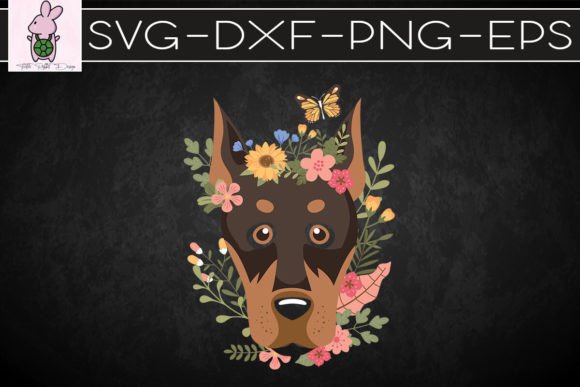
Floral Doberman Spring SVG
A Designer’s First Glance: Whimsy with Purpose
Opening Floral Doberman Spring SVG feels like unboxing a spring morning—light, intentional, and quietly confident. It’s not just a dog silhouette draped in florals; it’s a balanced composition where the Doberman’s clean profile anchors delicate blossoms and soft vines. The lines flow without overcrowding, and the negative space breathes. As an embroidery designer who’s stitched hundreds of pet-themed pieces—from boutique baby onesies to custom aprons for dog-loving bakers—I immediately saw its potential beyond decals. This isn’t filler graphics material. It’s a machine embroidery design waiting for thoughtful translation into thread.
Real Project Test: Embroidering a Custom Tote for a Local Dog Rescue Pop-Up
Last week, I prepped a limited-run embroidered tote bag for a spring fundraiser. The client wanted something joyful but not cutesy—professional enough for volunteers to carry at events, warm enough to resonate with adopters. I chose Floral Doberman Spring SVG as the centerpiece. Why? Because its vertical orientation fits perfectly on the tote’s front panel, and the floral elements soften the Doberman’s bold silhouette just enough to feel inclusive—not intimidating, not saccharine. In practice, the design held up beautifully on medium-weight canvas with tear-away stabilizer. The satin-stitched petals retained crisp edges, and the fill-stitched leaves didn’t puddle or shift, even across seams.
Where It Shines—and Where It Asks for Care
Floral Doberman Spring SVG excels in projects where charm meets clarity: sweatshirt embroidery (especially on crewnecks), pillow covers for nurseries or dog-themed guest rooms, tea towels for artisanal bakeries, and embroidered patches for volunteer vests. Its moderate detail level means it scales well from 3.5" to 5"—ideal for both small hoop work and larger finished products. I’ve used it on baby embroidery (onesies and burp cloths) by simplifying the outer vine layer—just two color stops instead of four—and the result felt handmade, not mass-produced.
That said, it’s not universally forgiving. On thin or stretchy fabric—like lightweight jersey tees or ribbed knit caps—some finer floral tendrils risk distortion without proper cutaway stabilizer and reduced stitch density. And on dark fabric, those light-petaled areas need careful thread color selection: a pale yellow satin stitch can vanish unless backed with white underlay or paired with high-contrast thread. Also, avoid placing it directly over curved surfaces like cap fronts without testing the hooping tension first—the Doberman’s ear tip and lower jaw are precise points that’ll telegraph any puckering.
What Customers Actually Notice (and Why It Matters)
Your buyers don’t read file specs—they feel cohesion. When I added Floral Doberman Spring SVG to a set of personalized gifts for an Etsy shop specializing in rescue-themed merchandise, repeat customers commented on how “thoughtful” the design felt—not just “a dog with flowers,” but a story told in line and bloom. That perception lifts perceived value. A customer paying $48 for a linen pillow cover doesn’t just want stitching; they want assurance that the design was chosen *with intention*. This digital embroidery file delivers that quiet professionalism because it avoids visual noise. No tiny lettering to fail mid-stitch. No overlapping dense fills that bleed into each other. Just clear hierarchy: dog first, florals second, breathing room always present.
Practical Notes Every Embroidery Designer Should Run Through
- Test before committing: Stitch Floral Doberman Spring SVG on scrap fabric matching your final project’s weight and weave—even if it’s “just a tote.” Thread tension shifts more than you think between cotton duck and brushed poly.
- Check contrast early: View your thread palette against both light and dark fabric mockups. Some floral accents look vibrant on ivory but muddy on navy unless you swap to metallic or variegated thread.
- Stabilizer isn’t optional—it’s part of the design: For structured items (caps, patches, aprons), use cutaway. For softer goods (towels, baby blankets), try wash-away + tear-away combo to preserve drape.
- Review stitch density visually: Zoom in on the floral clusters in your embroidery software. If fill stitches appear tightly packed with little airflow, consider reducing density by 5–8%—especially for wearable items that’ll be washed often.
- Confirm licensing scope: Since this is listed as a Graphics product in the Crafts category, double-check the seller’s terms before using it in commercial embroidery, printable mockups, or digital product previews sold on Etsy or your own site.
- Think beyond the hoop: Does this design support your brand consistency? For a craft business focused on modern botanicals and pets, yes—it reinforces aesthetic continuity. For a shop leaning into rustic farmhouse or minimalist monochrome? It may need subtle editing or pairing with simpler companion motifs.
Final Thought: Not Just Another Design Asset—A Conversation Starter
I keep returning to Floral Doberman Spring SVG because it bridges function and feeling so cleanly. It’s not overly technical, yet it rewards attention to detail. It’s not generic, yet it adapts across product types—from holiday embroidery on kitchen towels to wedding gifts for couples who met at a dog park. As a designer, I trust it to represent my clients’ stories without needing heavy reinterpretation. As a small shop owner, I know it helps customers pause, smile, and say, “That’s *us*.” That kind of resonance? That’s what turns a simple embroidery project into a meaningful finished product.