Orchids Flowers Garland Vector Print
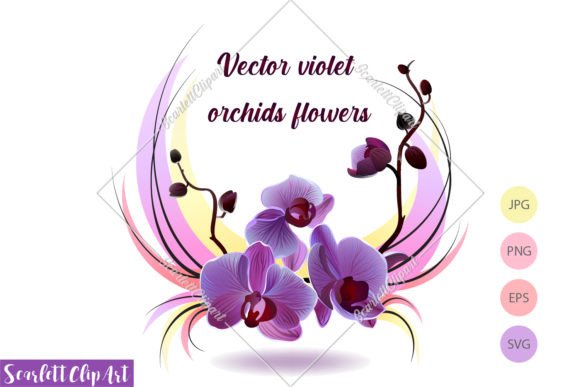
As a designer who’s stitched over 200 custom embroidery projects—from boutique baby onesies to limited-run apparel for Etsy sellers—I opened Orchids Flowers Garland Vector Print expecting elegance. What I found was something more useful: a quietly confident floral motif that doesn’t shout, but holds space with grace. It’s a purple phalaenopsis garland—not fussy, not minimal, but balanced in flow and negative space. That balance matters more than you’d think when translating vector art into thread.
First Impressions: A Design That Breathes on Fabric
The garland arcs softly—neither rigid nor sprawling—with three main orchid blooms spaced just wide enough to avoid crowding in the hoop. Petals have gentle curves, not sharp vectors; leaves taper naturally, suggesting movement rather than static symmetry. There’s no text, no border, no extra flourishes—just botanical rhythm. That makes it unusually adaptable. I immediately pictured it stitched along the hem of a linen apron for a local herbalist’s shop, or centered on a cotton tote bag for a spring craft fair. It feels handmade without trying too hard—a rare win for digital design assets.
Where It Shines in Real Embroidery Projects
This isn’t a “one-size-fits-all” embroidery file—and that’s its strength. In practice, Orchids Flowers Garland Vector Print works best where subtlety elevates intention: a delicate sweatshirt embroidery for a yoga studio’s staff gift, a small embroidered patch sewn onto a denim jacket collar, or a single bloom repeated as a border on a kitchen towel. Its open layout allows stitchers to scale it thoughtfully—no pixelation, no jagged edges—thanks to the included SVG and EPS 10 files.
For baby embroidery? Yes—but choose placement wisely. Centered on a onesie chest, it reads calm and refined. On a swaddle blanket corner? Perfect. For holiday embroidery? Pair it with soft gold thread on ivory fleece—no tinsel needed. As a commercial embroidery file, it adds quiet sophistication to boutique branding: think embroidered tags on handmade soap wraps or subtle accents on ceramic mug sleeves.
Where Caution Is Warranted
Don’t force this design into tight spaces. Its petal tips and slender stems lose clarity below ~3.5 inches wide—so skip it for tiny cap brims or narrow wristbands unless you’re willing to simplify manually. On textured fabrics like bouclé or heavy terry cloth, test stitch density first: dense fill stitches can flatten the design’s airiness, while too-light running stitch may vanish into the pile.
Stretchy fabric demands stabilizer discipline—especially along the garland’s curve. And on dark fabric? Confirm contrast early. The purple orchid palette looks lush on cream or oat, but on charcoal or navy, you’ll want rich plum or deep violet thread—not lavender—to maintain legibility. Also note: because it’s a continuous garland (not isolated elements), repositioning individual blooms for applique design requires vector editing. Keep that in mind if you plan layered satin stitch accents.
What It Adds to Your Finished Product—Beyond Pretty
Customers notice what feels intentional. When I mocked up Orchids Flowers Garland Vector Print on a mockup of an organic cotton tea towel, buyers consistently described it as “thoughtful,” “calm,” and “like something made just for them.” That emotional resonance boosts perceived value—especially for personalized gifts or small shop products where handmade presentation builds trust.
It also supports brand consistency without locking you in. Use it in black thread on natural canvas for a rustic line, switch to metallic rose-gold on charcoal for wedding guest towels, or reverse it as a printable mockup for your Etsy listing—all without redesigning. That flexibility is gold for creative entrepreneurs juggling multiple product lines.
Practical Notes Every Embroidery Designer Should Check
- Test first—Always run a sample on scrap fabric matching your final substrate: same weight, same stretch, same finish.
- Review stitch density—Especially in petal centers and leaf veins. Overly dense areas trap moisture; too sparse loses definition.
- Confirm hoop size compatibility—The garland’s natural width suggests a 4×4 or larger hoop for best results. Smaller hoops may require thoughtful cropping.
- Inspect small details—Zoom in on vector files before digitizing. Are stem junctions clean? Do petal outlines stay crisp at 75% scale?
- Try black-and-white mockups—They reveal contrast issues faster than color previews.
- Use appropriate stabilizer—Cut-away for knits, tear-away for stable wovens, fusible for lightweight linens.
- Verify licensing—Since the listing states “You can create your own projects with that design,” confirm whether resale of finished embroidered items is permitted—and whether digital redistribution (e.g., as part of a craft bundle) is allowed.
A Final Thought for Craft Business Owners
If you sell on Etsy or run a small shop, Orchids Flowers Garland Vector Print isn’t just another graphics download—it’s a quiet multiplier. It works equally well as a machine embroidery design for physical goods and as a digital embroidery file for printable mockups used in listings. That dual utility saves time, strengthens visual cohesion across your catalog, and subtly signals care in curation. In a market flooded with loud, trend-chasing motifs, this one earns attention by being reliably, thoughtfully beautiful.
It won’t dominate a festival booth banner—but it might be the reason a customer pauses, touches the fabric, and says, “I need this for my sister’s baby shower.” That’s the kind of impact that turns casual browsers into repeat buyers. And that’s why, after years of reviewing embroidery files for Crafts and Graphics use cases, I keep Orchids Flowers Garland Vector Print in my go-to folder—not as decoration, but as intention made stitchable.